
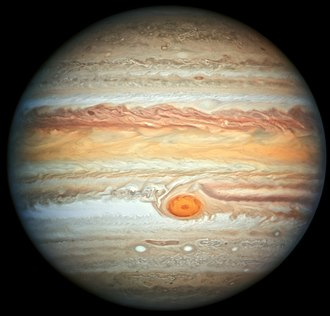
Jupiter, image taken by NASA's Hubble Space Telescope, June 2019
Jupiter’s Mean Temperature Calculation at 1 bar level
Jupiter’s Mean Temperature Equation Tmean.jupiter.1bar is:
Tmean.jupiter.1bar = [Φ (1-a) So (1/R²) (B*N)¹∕ ⁴ /4σ]¹∕ ⁴
Jupiter’s sidereal rotation period is 9,925 h
N = 24h/9,925h rotations/per day
R = 5,2044 AU, 1/R² = 1/5,2044² = 0,0369 times lesser is the solar irradiation on Jupiter than that on Earth.
So = 1.361 W/m² is Solar constant
Jupiter’s albedo, ajupiter = 0,503
Jupiter is a gaseous planet, Jupiter’s surface irradiation accepting factor Φjupiter = 1
(Jupiter has not surface to reflect the incident sunlight. Accepted by a Gaseous Hemisphere with radius r sunlight is S*Φ*π*r²(1-a), where Φ = 1)
Atmosphere composition 89% ± 2,0% H₂, 10% ± 2,0% He, 0,3% ± 0,1% CH₄.
Jupiter has not surface
B = 850 days/rotation – it is the Rotating Gaseous Planet at 1 bar level (Jupiter, Saturn, Uranus and Neptune very similar atmosphere composition) Rotating Planet Solar Irradiation INTERACTING-Emitting constant
σ = 5,67*10⁻⁸ W/m²K⁴, a Stefan-Boltzmann constant
So we have:
Jupiter’s mean temperature at 1 bar level Tmean.jupiter.1bar is:
Tmean.jupiter.1bar = {1*(1-0,503)1.361*0,0369(W/m²) [850*(24h/9,925h)]¹∕ ⁴ /4*5,67*10⁻⁸(W/m²K⁴) }¹∕ ⁴ =
Tmean.jupiter.1bar = {1*(0,497)1.361*0,0369(W/m²) [850*2,417]¹∕ ⁴ /4*5,67*10⁻⁸(W/m²K⁴) }¹∕ ⁴ =
Tmean.jupiter.1bar = {1*(0,497)1.361*0,0369(W/m²) [2.054,45]¹∕ ⁴ /4*5,67*10⁻⁸(W/m²K⁴) }¹∕ ⁴ =
Tmean.jupiter.1bar = {1*(0,497)1.361*0,0369(W/m²) *6,732 /4*5,67*10⁻⁸(W/m²K⁴) }¹∕ ⁴ =
Tmean.jupiter.1bar = (740.869.877)¹∕ ⁴ = 165 K
Tmean.jupiter.1bar = 165 K is the calculated.
And below is the measured by satellites
Tsat.mean.jupiter = 165 K (at 1bar level)
Tsat.mean.jupiter = 112 K (at 0,1 bar level).
Here is an abstract from Wikipedia:
Atmosphere Main article: Atmosphere of Jupiter
Jupiter has the largest planetary atmosphere in the Solar System, spanning over 5,000 km (3,000 mi) in altitude.[55][56] Because Jupiter has no surface, the base of its atmosphere is usually considered to be the point at which atmospheric pressure is equal to 100 kPa (1.0 bar).

Io, Jupiter's moon, highest resolution true color
.
https://www.cristos-vournas.com
The faster a planet rotates (n2>n1)
Tmin↑→ T↑mean ← T↓max
.