


The combined double effect (more heat absorption and more even the absorbed heat distribution)
Two bodies subjected to the same flux. It is always there - a strongly irradiated area (24/7), which area moves on the rotating surface, but which always faces sun. The planet 2, whith a higher Ncp product develops lower IR-emitting conditions(temperatures), and the planet 1, with a lower Ncp product develops higher IR-emitting conditions 🟠 Immediate IR1 > Immediate IR2 The planet 2 is not so hot at local noon hours, so it gives Immediatelly out less IR, so less heat is immediatelly lost. The planet 1 is warmer at local noon hours, but those higher temperatures only weakly affect locally the planet average surface temperature rise, as it influences at their first power (T), whereas those higher temperatures - IR emission at fourth power (T^4) - they, at the same time, they lessen the average surface temperature significantly, because those the higher local noon temperatures contemplate for the much higher Immediate IR energy emission. 👉 Tmean2 > Tmean1 The higher Immediate IR emissi
14 June 2026
The Average emitted by Earth's surface EM energy is not the 398,2 W/m2
Here it is something interesting: " Find at least ONE thing wrong with this graphic: Link: temp Image EI77l1 — Postimages It should be easy, as there are several things wrong. " - The simplest one is the mistaken assertion that the The Average emitted by Earth's surface EM energy is 398,2 W/m2 which is utterly wrong, because It cannot be so, because it assumes Earth's surface emits at its average surface temperature 288K. The average surface temperature is not a temperature per ce! It is only a number for comparison. Example: our Moon and planet Mars for equal Albedo (the Marsian a= 0,250) would have the same average surface temperature 210K. Moon and Mars do not emit the same amount of EM energy, because Mars is at 1,53 AU from sun, when Moon is at 1 AU from sun! Thus, The solar flux on Moon is So = 1362 W/m2 The solar flux on Mars is S = 586,4 W/m2 yet the average surface temperature for the same Albedo (a = 0,250) for both, Moon and Mars, is 210K !!!
9 August 2025
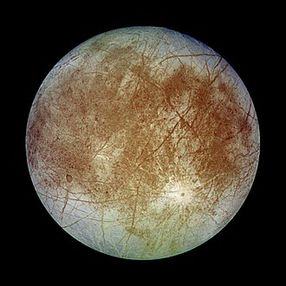
7. Europa’s Average Temp Calculation
7. Europa’s (Jupiter’s satellite) Mean Surface Temperature Calculation Tmean.europa So = 1.361 W/m² (So is the Solar constant) Europa’s albedo: aeuropa = 0,63 Europa is an ice-crust planet (rocky) without atmosphere, Europa’s surface irradiation accepting factor Φeuropa = 0,47 Europa’s surface consists of water ice crust Cp.europa = 1cal/gr*oC 1/R² = 1/5,2044² = 0,0369 times lesser is the solar irradiation on Jupiter than that on Earth, the same on its satellite Europa. Europa’s orbital period is 3,5512 d Europa’s sidereal rotation period is synchronous N = 1/3,5512 rotation /day β = 150 days*gr*oC/rotation*cal – it is the Planet Surface Solar Irradiation INTERACTING-Emitting Universal Law constant σ = 5,67*10⁻⁸ W/m²K⁴, a Stefan-Boltzmann constant Europa’s mean surface temperature equation Tmean.europa is: Tmean.europa = [ Φ (1-a) So (1/R²) (β*N*cp)¹∕ ⁴ /4σ ]¹∕ ⁴ Τmean.europa = { 0,47(1-0,63)1.362 W/m² *0.0369*[150* (1/3,5512)*1]¹∕ ⁴ /4*5,67*10⁻⁸ W/m²K⁴}¹∕ ⁴ = Tmean.europa = 99,557 K
31 May 2025

6. Io’s Average Temp Calculation
6. Io’s ( Jupiter’s satellite ) Mean Surface Temperature Calculation Tmean.io So = 1.361 W/m² (So is the Solar constant) Io’s albedo: aio = 0,63 Io is a rocky planet without atmosphere heavy cratered, Io’s surface irradiation accepting factor Φio = 1 Most of Io's surface is composed of sulfur and sulfur dioxide frost. Cp.sulfur = 0,17 cal/gr.oC, Cp.sulfur.dioxide = 0,12 cal/gr.oC cp.io = 0,17 cal/gr.oC *0,5 + 0,12 cal/gr.oC *0,5 = cp.io = 0,145 cal/gr.oC β = 150 days*gr*oC/rotation*cal – it is the Planet Surface Solar Irradiation INTERACTING-Emitting Universal Law constant σ = 5,67*10⁻⁸ W/m²K⁴, the Stefan-Boltzmann constant 1/R² = 1/5,2044² = 0,0369 times lesser is the solar irradiation on Jupiter than that on Earth, the same on its satellite Io. Io’s orbital period is 1,799 days. Io’s sidereal rotation period is synchronous. N = 1/1,799 rotations/per day IO'S MEAN SURFACE TEMPERATURE EQUATION Tmean.io is: Tmean.io = [ Φ (1-a) So (1/R²) (β*N*cp)¹∕ ⁴ /4σ ]¹∕ ⁴ Τmean.io = { 1*(1-0,63)1.3
31 May 2025
3. Mars’ Mean Surface Temperature calculation.
3. Mars’ Mean Surface Temperature calculation. Tmean.mars Surface temp..Tmin..Tmean..Tmax Kelvin...................130.K.....210.K....308.K (1/R²) = (1/1,524²) = 1/2,32 Mars has 2,32 times less solar irradiation intensity than Earth has Mars’ albedo: amars = 0,25 Mars performs 1 rotation every 1,028 day For Mars N = 1 /1,028 = 0,9728 rotations /day (or 0,9728 marsian day /per an earthen day) Mars is a rocky planet, Mars’ surface irradiation accepting factor: Φmars = 0,47 cp.mars = 0,18cal/gr oC, on Mars’ surface is prevalent the iron oxide. β = 150 days*gr*oC/rotation*cal – ( the Rotational Warming Factor constant ). σ = 5,67*10⁻⁸ W/m²K⁴, the Stefan-Boltzmann constant. Mars' Mean Surface Temperature Equation is: Tmean.mars = [ Φ (1-a) So (1/R²) (β*N*cp)¹∕ ⁴ /4σ ]¹∕ ⁴ Tmean.mars = [ 0,47 (1-0,25) 1.361 W/m²*(1/2,32)*(150*0,9728*0,18)¹∕ ⁴ /4*5,67*10⁻⁸ W/m²K⁴ ]¹∕ ⁴ = =( 2.066.635.457,46 )¹∕ ⁴ = 213,21 K Tmean.mars = 213,21 K The calculated Mars’ mean surface temperature Tmean.mars = 213,
30 May 2025
2. Moon’s Mean Surface Temperature calculation.
2. Moon’s Mean Surface Temperature calculation. Tmean.moon Surface temp..Tmin....Tmean...Tmax.. Kelvin ................................100.K......220.K.....390.K So = 1.361 W/m² (So is the Solar constant) Moon’s albedo: amoon = 0,11 Moon’s sidereal rotation period with reference to the stars is 27,32 earthen days. But Moon also orbits sun, so the lunar day is 29,5 earthen days. Moon does N = 1/29,5 rotations/per day Moon is a rocky planet, Moon’s surface irradiation accepting factor Φmoon = 0,47 (Accepted by a Smooth Hemisphere with radius r sunlight is S* Φ*π*r²*(1-a), where Φ = 0,47) cp.moon = 0,19cal/gr oC, moon’s surface specific heat (moon’s surface is considered as a dry soil) β = 150 days*gr*oC/rotation*cal – ( the Rotational Warming Factor constant ). σ = 5,67*10⁻⁸ W/m²K⁴, the Stefan-Boltzmann constant. Moon’s Mean Surface Temperature Equation Tmean.moon: Tmean.moon = [ Φ (1 - a) So (β*N*cp)¹∕ ⁴ /4σ ]¹∕ ⁴ Tmean.moon = { 0,47 (1 - 0,11) 1.361 W/m² [150* (1/29,5)*0,19]¹∕ ⁴ /4*5,
30 May 2025